substitution
Learn about the substitution extension point.
| Name | Type | Description |
|---|---|---|
append | bool | Adds raw to the end of tokens, assuming both are defined. |
ignorecase | bool | Makes all matches case-insensitive. |
nonword | bool | Removes the default word boundaries (\b). |
swap | map | A sequence of observed: expected pairs. |
exceptions | array | An array of strings to be ignored. |
vocab | bool | If false, disables all active vocabularies for this rule (default: true). |
capitalize | bool | Matches the capitalization of the source token. |
substitution associates a string with a preferred form.
yamlextends: substitution message: Consider using '%s' instead of '%s' level: warning ignorecase: false # swap maps tokens in form of bad: good swap: abundance: plenty accelerate: speed up
If we want to suggest the use of “plenty” instead of “abundance,” for example, we’d write:
yamlswap: abundance: plenty
Regex keys
The keys may also be regular expressions:
yamlswap: '(?:give|gave) rise to': lead to
You can also reference capture groups for more dynamic substitutions:
yamlswap: 'within the (.*)?directory': in the $1 directory
Multiple suggestions
In some cases, you may want to suggest multiple alternatives for a single token. You can do this by separating them with a pipe (”|”):
yamlextends: substitution # NOTE: We don't quote the first '%s': message: Consider using %s instead of '%s.' level: warning # NOTE: The action is required. action: name: replace swap: # You can suggest multiple alternatives for a single token # by separating them with a pipe ("|"). masterful: skilled|authoritative|commanding
In the CLI, this will render as a sentence with multiple suggestions:
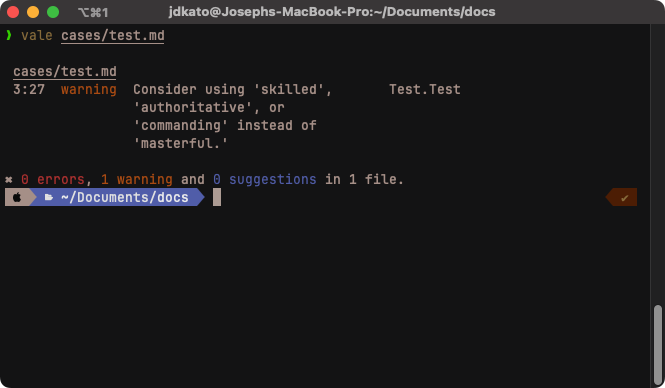
In LSP-based editors, the suggestions will be presented as a list of ‘Quick Fixes’. See the LSP guide for more information.
message
substitution can have one or two %s format specifiers in its message. This
allows us to do either of the following:
yamlmessage: "Consider using '%s' instead of '%s'." # or message: "Consider using '%s'."
On This Page